

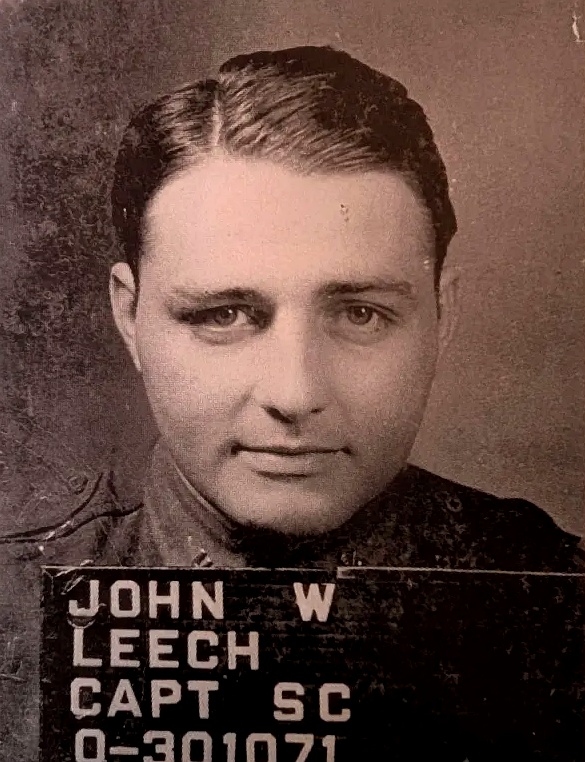
 After John Leech graduated from Ohio State University in the mid-1930s, he spent time working as an engineer at the old Picway Power Plant in Lockbourne, on the southern outskirts of Columbus. He was working on the plant’s expansion project when the United States Army came calling.
While at OSU, John had been in the Army ROTC and after graduation joined the Signal Corps Reserve, achieving the rank of First Lieutenant by the time the war broke out in Europe. In the time between graduation and Uncle Sam’s call in April of 1941, John and his wife Mary had started a family – bringing their young son and daughter with them when John was assigned to the 63rd Signal Battalion at Camp Claiborne, Louisiana, on a one-year assignment. He was supposed to help stand up the Battalion by commanding Company A, the construction company, and then go back to his civilian life.
On his way to Claiborne, he stopped at a restaurant in Louisiana and got to talking with the woman behind the counter. She handed him a 1913 Liberty dime and told him to carry it for luck. He folded it in a piece of paper, tucked it in his billfold, and it was still there more than fifty years later – “black as coal,” he said, but still with him.
At the end of 1941 any talk of a one-year commitment came to an end when the Japanese attacked Pearl Harbor. The 63rd shipped overseas in early 1942, and Leech spent the next three and a half years leading Company A across Northern Ireland, North Africa, and Italy. In Ireland, while the men were still adjusting to life overseas, a detachment of his men assigned to a British unit sent an urgent request for emergency rations – they weren’t getting enough food. Baffled, Leech called the British commanding officer, who explained that the Americans were attending breakfast and lunch but skipping the 10 a.m. and 4 p.m. 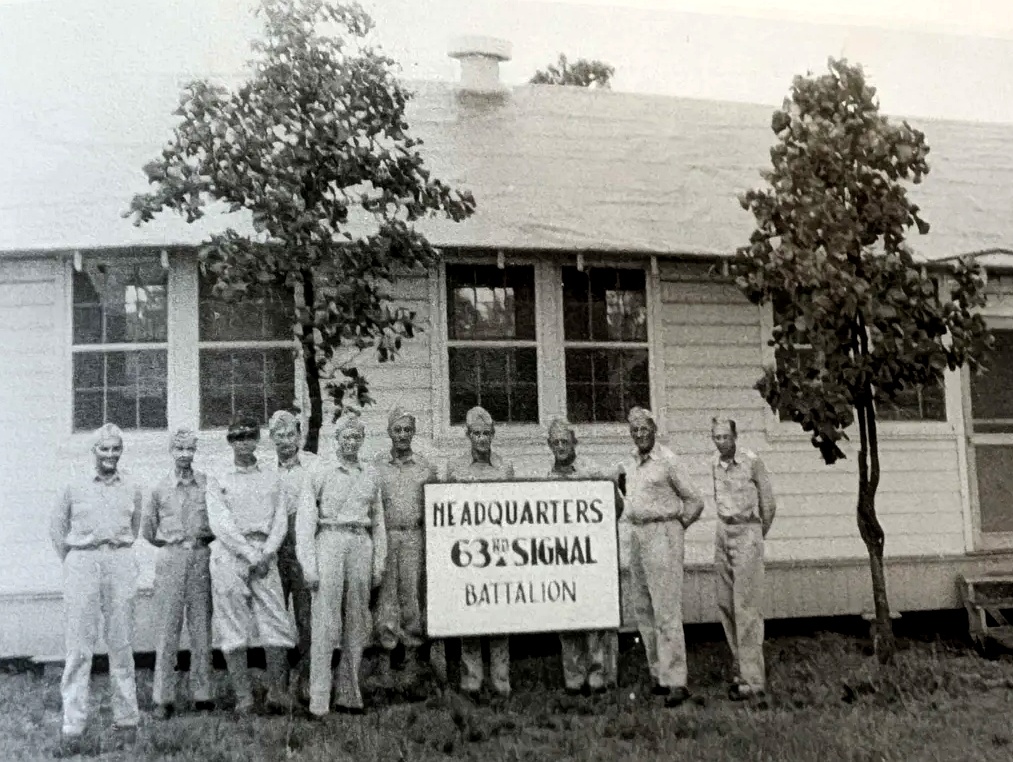 “tea times,” which were full meals. Leech told his men to show up for tea, and the crisis was resolved.
In Algiers, where the 63rd ran communications for Allied Forces Headquarters, Leech and his adjutant, Jim Hubbard, tried reading the Book of Revelation together in their tent one night. An air raid interrupted them. They tried again the next night – another air raid. After the third night in a row, Leech told Hubbard, “We’re not supposed to be doing this. All we’re doing is calling down the wrath of God on us.” They laughed and gave it up – though the air raids, of course, continued regardless.
Assigned to the United States 5th Army, Leech led Company A through the invasion of Italy – from Naples to Cassino, Anzio to Rome, Florence to Verona. They rebuilt communications lines that had been destroyed across western Italy, often with scarce materials and construction crews that were spread thin. During the May 1944 push toward Rome, multiple construction units were placed under Leech’s command – a recognition of both his competence and the standard his Company A had set. Always focused on the next steps of a project and the possible downstream consequences of his decisions, Leech kept his men moving forward. It was a trait his family always recognized in him – along with a favorite quote, often attributed to Winston Churchill: “Success is not final, failure is not fatal: it is the courage to continue that counts.”
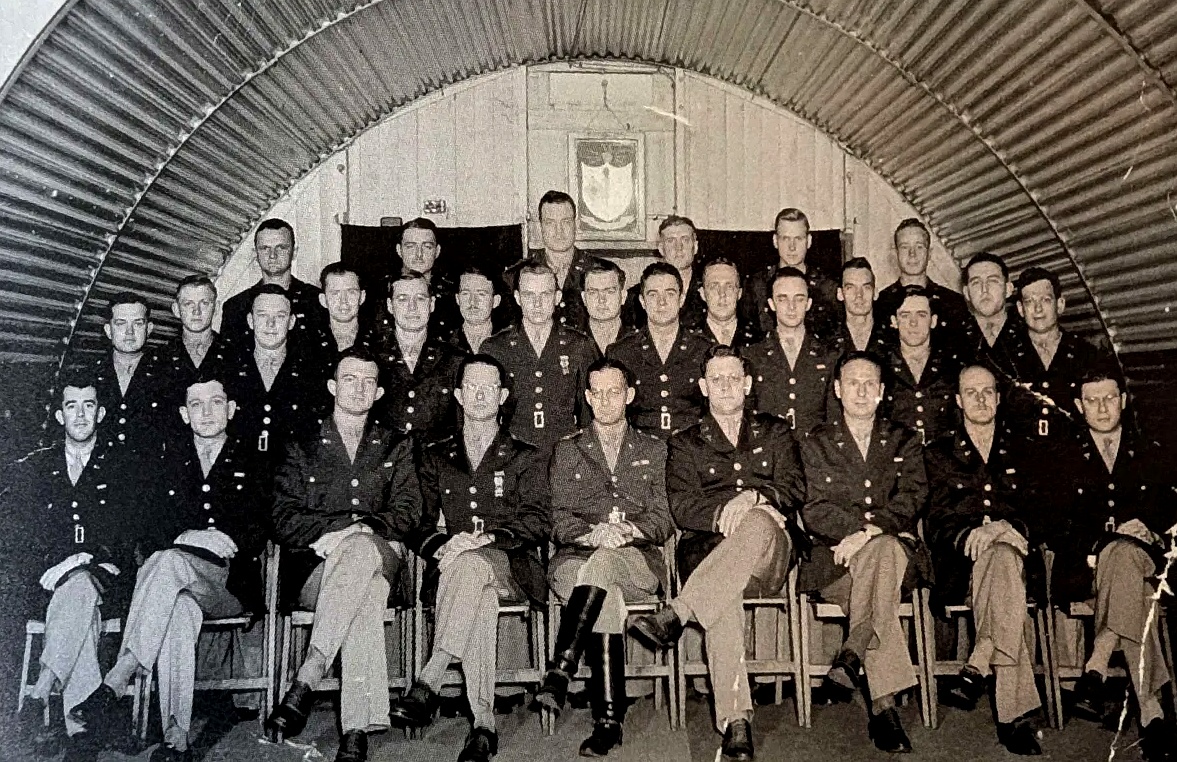 When the war in Italy ended in May 1945, the 63rd was camped near Verona, in northern Italy. It was the first time all units of the battalion had been in the same place since North Africa – and before that, Ireland, and before that, Camp Claiborne. From the day they shipped out in January 1942, the 63rd had almost never been whole. Over the course of the war, the battalion served in five countries, supported operations from the invasion of North Africa to the liberation of Italy, and kept communications running for not just the 5th Army but the Allied Forces Headquarters. They strung lines under fire, swept mines to reach downed cables, improvised with whatever they had, and rebuilt what the war destroyed – often before the dust had settled. Through it all, Company A was at the front of the work.
Looking back on nearly five years of service, Leech reflected that though he saw action on two continents and led countless construction projects under the worst conditions, Mary may have had the harder road: raising two children alone, working, and not knowing if he would come back. “I have a lot of respect beside love for that woman,” he said. And of his own role, he put it simply: “I don’t want to leave you with the idea that I won the war, just that I was in there.”
John Leech came home in early 1946, weighing exactly what he had going in – 183 pounds – and picked up where he left off: building a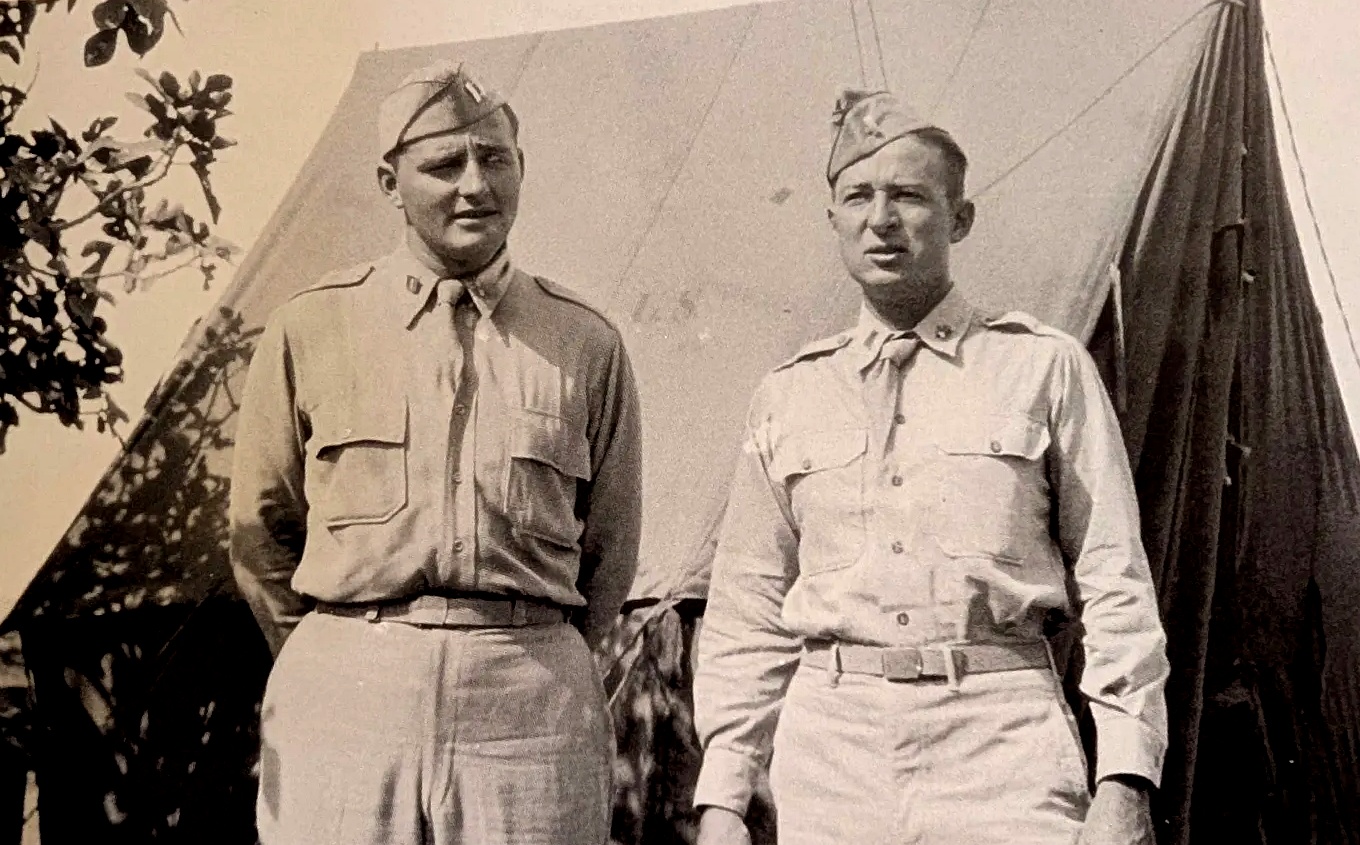 life in Columbus with Mary, Roberta, and John. He built a career at Columbus Southern Power, eventually becoming Director of Rates and Evaluations, and settled the family in Upper Arlington. The man who always had his eye on the next step was still planning ahead in 1985 when he answered an ad about tax-free municipal bonds placed by a young advisor named Dan. The lucky dime stayed in his billfold. The courage to continue stayed with him, too – and he passed it on. His son Jack, also an Ohio State man, became a client, as did his granddaughter and her two sons. Four generations later, the Leech family’s relationship with ours is still going strong.